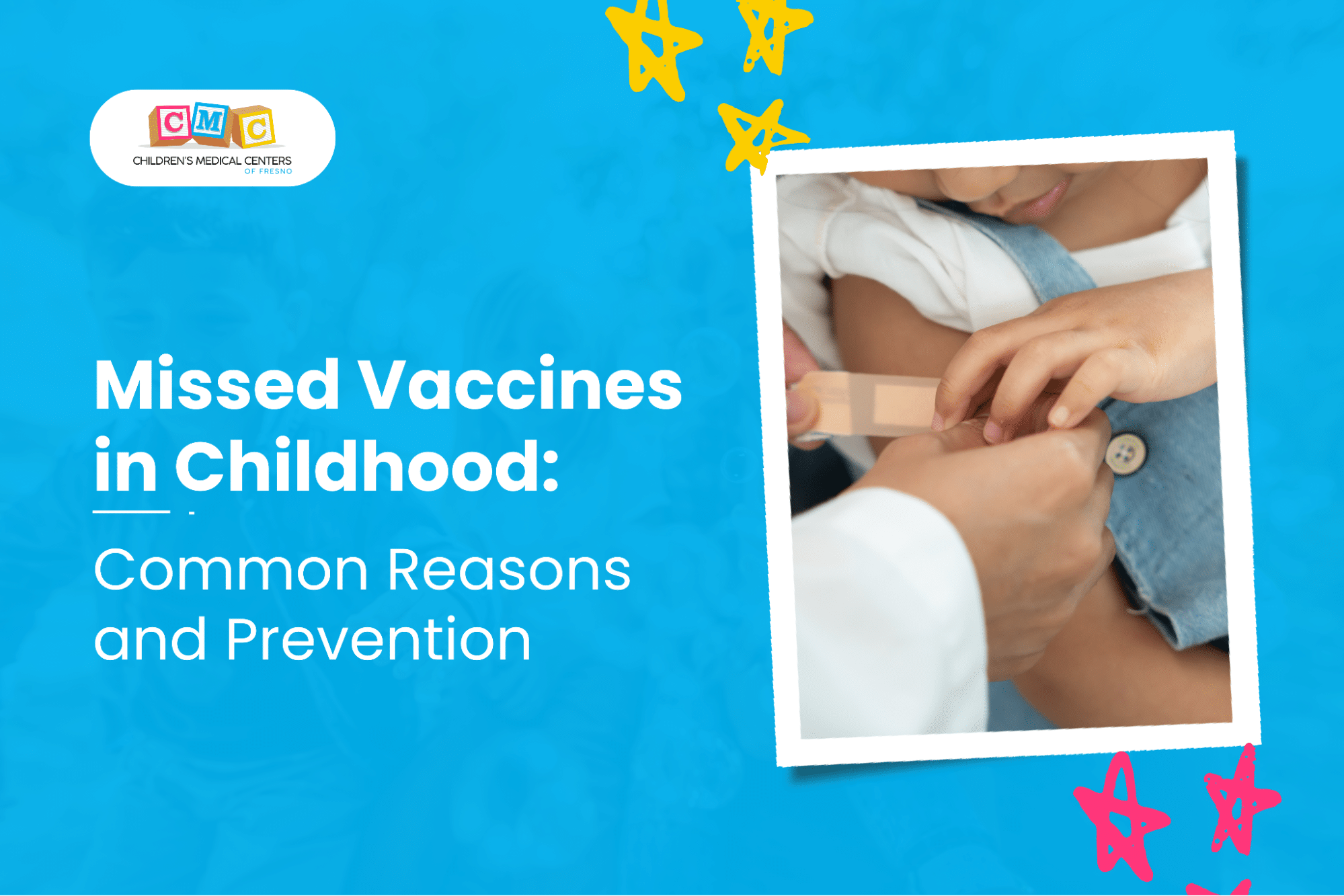
Life happens. Appointments get missed. Kids get sick right before their scheduled shot, or a move across town puts everything on hold. If your child has fallen behind on their vaccines, you are not alone, and you are not a bad parent.
But here is what matters: missed vaccines in childhood are not the end of the road. They are a gap that needs to be closed, and the sooner the better. This guide breaks down why gaps happen, what they mean for your child’s health, and exactly how to fix them, including how CMCFresno helps families like yours get back on track.
Catch up before Diseases Catch up First
Book an Appointment Now
Why Childhood Vaccination Schedules Matter
The childhood vaccination schedule is not random. Every dose is timed based on when a child’s immune system is most ready to respond and when they are most vulnerable to certain diseases.
Vaccines for measles, whooping cough, polio, and other preventable diseases are given at specific ages because that is when protection matters most. Miss that window, and your child spends extra time unprotected, sometimes during the very period when exposure risk is highest.
Childhood vaccination schedules also work on a community level. When enough children are vaccinated, it becomes harder for the disease to spread. Every missed dose is a small crack in that protection, not just for one child, but for an entire community.
What Happens If a Vaccine Is Missed
Missing a scheduled vaccine does not mean your child is doomed. You also don’t have to worry about restarting that entire immunization series. But it does mean your child is temporarily vulnerable.
Depending on which vaccine was missed and how much time has passed, the risks vary. A child who missed their MMR vaccine is unprotected against measles, a disease that spreads through the air and can cause serious complications. A child behind on their DTaP is at risk for whooping cough, which can be life-threatening in infants.
The immune system does not hold grudges. A missed vaccine can still be given, and in most cases, the immune response will be just as strong.
Can Children Catch Up on Missed Vaccines?
Yes, absolutely. The catch-up vaccination schedule exists precisely for this reason.
Healthcare providers follow guidelines from organizations like the CDC and the American Academy of Pediatrics. These guidelines include detailed catch-up protocols for every recommended vaccine. Whether your child missed one dose or is behind on several, there is a plan for them.
The key is acting on it. The longer a gap goes unaddressed, the longer your child remains unprotected.
How Catch-Up Vaccination Works
Catch-up vaccination is the process of giving missed or delayed vaccines according to a modified schedule. These schedules are designed to get a child protected as efficiently and safely as possible.
Here is what the process typically looks like:
- Review your child’s immunization record to identify which vaccines were missed and which doses of multi-dose series are still needed
- Visit your pediatrician or a clinic (like CMCFresno) who will cross-reference records with the current catch-up schedule
- Receive a customized plan that prioritizes which vaccines to give first, especially if multiple are needed
- Follow through on follow-up doses for vaccines that require more than one shot
Some vaccines can be given simultaneously. Others have minimum intervals between doses that must be respected. Your provider will navigate all of this for you.
Common Reasons for Missed Vaccines
Understanding why missed vaccines in childhood happen helps prevent them from happening again.
- Illness on the appointment day – Most mild illnesses are not a reason to delay vaccination, but many parents and even some providers reschedule unnecessarily.
- Fear of side effects – Worry about pain, fever, or fussiness leads some families to delay or skip doses. These side effects are almost always mild and temporary.
- Access and logistics – Work schedules, transportation issues, and lack of insurance are real barriers, especially in underserved communities.
- Misinformation – False claims about vaccine safety circulate widely online and cause some parents to hesitate.
- Moving or changing providers – Records get lost, referrals fall through, and follow-up appointments slip through the cracks.
- The COVID-19 pandemic – Millions of children worldwide fell behind during lockdowns, a backlog that many health systems are still working through.
Which Vaccines Are Most Important to Catch Up
All vaccines on the recommended child’s immunization schedule matter, but some require more urgency than others.
| Vaccine | Why It’s Urgent |
|---|
| MMR (Measles, Mumps, Rubella) | Measles spreads very easily and can be severe |
| DTaP (Diphtheria, Tetanus, Pertussis) | Whooping cough is dangerous for young children |
| Hib (Haemophilus influenzae type b) | Critical for children under 5 |
| Hepatitis B | Three-dose series; delays mean extended unprotected periods |
| Varicella (Chickenpox) | Highly contagious; complications are preventable |
| PCV (Pneumococcal) | Protects against bacterial infections, including meningitis |
Your child’s provider will assess age, previous doses received, and current child development services health status to determine the most critical vaccines to prioritize.
Is It Safe to Take Multiple Vaccines Together?
Yes. This is one of the most common concerns parents bring up, and the answer is clear: giving multiple vaccines in one visit is safe and effective.
The catch-up vaccination schedule routinely involves administering more than one vaccine at a time. The immune system is capable of handling several antigens simultaneously. In fact, every day your child’s body responds to hundreds of environmental exposures without being overwhelmed.
Combining vaccines also means fewer clinic visits, which reduces both the burden on families and the period of vulnerability.
Age and Catch-Up Vaccination
Age affects how catch-up vaccination is structured:
- Infants and toddlers catch up quickly and can often complete delayed series within a few months.
- School-age children may have different spacing requirements.
- Adolescents catching up on childhood vaccines may be eligible for combined doses.
For children over 7, some infant-specific formulations (like DTaP) are replaced with formulations designed for older children and adults (Tdap). Your provider knows which formulation is appropriate based on your child’s age.
The older a child gets, the more important it becomes to also assess whether adolescent vaccines (like HPV and meningococcal) need to be added alongside catch-up doses.
When Should You Delay Catch-Up Vaccination
There are genuine medical reasons to temporarily delay even catch-up vaccination:
- A child currently has a moderate or severe illness (mild illness is generally not a reason to wait)
- A child has a known severe allergic reaction to a vaccine component
- Certain immunocompromising conditions may require a modified approach for live vaccines
These situations are the exception, not the rule. Your CMCFresno provider will help determine whether the delay is truly warranted or whether vaccination can proceed safely.
Role of Parents in Catch-Up Vaccination
Parents have the most important role:
- Keep your child’s immunization records organized and accessible.
- Know which vaccines have been given and which are due.
- When you schedule an appointment, mention upfront that you want to review the vaccination schedule and address any gaps.
Providers at CMCFresno are there to help you understand what your child needs, why it matters, and what to expect. You do not need to navigate this alone.
Common Concerns About Catch-Up Vaccination
“Won’t giving multiple vaccines at once overwhelm my child’s immune system?”No. This is a common misconception. Children’s immune systems are robust and handle multiple vaccines without issue.
“My child already had the disease, do they still need the vaccine?” In some cases, natural infection provides immunity. But it is not always guaranteed to be complete or lifelong. Your provider can advise based on the specific disease.
“Is it too late to start a series?”It is almost never too late. Many vaccines can be initiated in older children, adolescents, or even adults.
“We lived outside the country, and I don’t have records.”This comes up often. In most cases, providers can either accept documented foreign vaccine records or restart the series conservatively. CMCFresno and similar clinics handle these situations routinely.
How to Stay on Track After Catch-Up
Once your child is caught up, the goal is to stay caught up. Here is how to make that easier:
- Set calendar reminders for every upcoming vaccine date
- Keep a digital copy of your child’s immunization record
- Communicate with your school to make sure records are up to date
- Schedule annual well-child visits so your provider can flag any upcoming vaccines
- Do not reschedule unnecessarily if your child has a mild cold
Staying on top of the child’s immunization schedule going forward means you will never have to play catch-up again.
Why Catch-Up Vaccination Should Not Be Delayed Further

Every day a child is unvaccinated is a day of real, preventable risk. Measles outbreaks happen. Whooping cough circulates. These are not historical diseases. They are real, active threats in communities today.
Catch-up vaccination is one of the most effective things you can do for your child’s long-term health. It is not about blame for the past. It is about protecting your child now and in the future.
CMCFresno is equipped to help families like yours assess their child’s immunization status, build a catch-up plan, and provide vaccines in a safe, supportive environment. Reaching out is the first and most important step.
Missed vaccines in childhood are common, correctable, and nothing to be ashamed of. The catch-up vaccination schedule is a well-tested, safe, and effective way to close the gap and restore your child’s protection against serious, preventable diseases.
What matters is not how the gap happened, but what you do about it. Talk to your child’s doctor. Visit a trusted clinic like CMCFresno. Get the plan in place. Your child’s immune system is ready, and so is the medical community, to meet you exactly where you are.
CMCFresno Makes Missed Vaccines a Distant Memory
Book an Appointment Now
A catch-up vaccination schedule is a personalized plan for children who have fallen behind on their recommended vaccines. It outlines which doses to give, in what order, and at what intervals to achieve full protection as safely and quickly as possible.
Yes. Healthcare providers are experienced at managing complex catch-up scenarios. Multiple vaccines can often be given at the same visit to accelerate protection.
No. In most cases, you simply continue from where you left off. The minimum intervals between doses still apply, but the series does not need to restart.
Review your child's immunization record and compare it against the CDC's recommended childhood vaccination schedule by age. Your pediatrician or a clinic like CMCFresno can also do this review for you.
Some vaccines are age-specific in their formulation, but most can be adapted. For example, the MMR vaccine can be given to children, adolescents, and adults who lack immunity. Your provider will recommend the right formulation for your child's age.
No. It is tailored based on the child's age, which vaccines they have already received, how much time has passed, and any relevant medical history.
 inquiry@cmcfresno.com
 (559) 455-1500