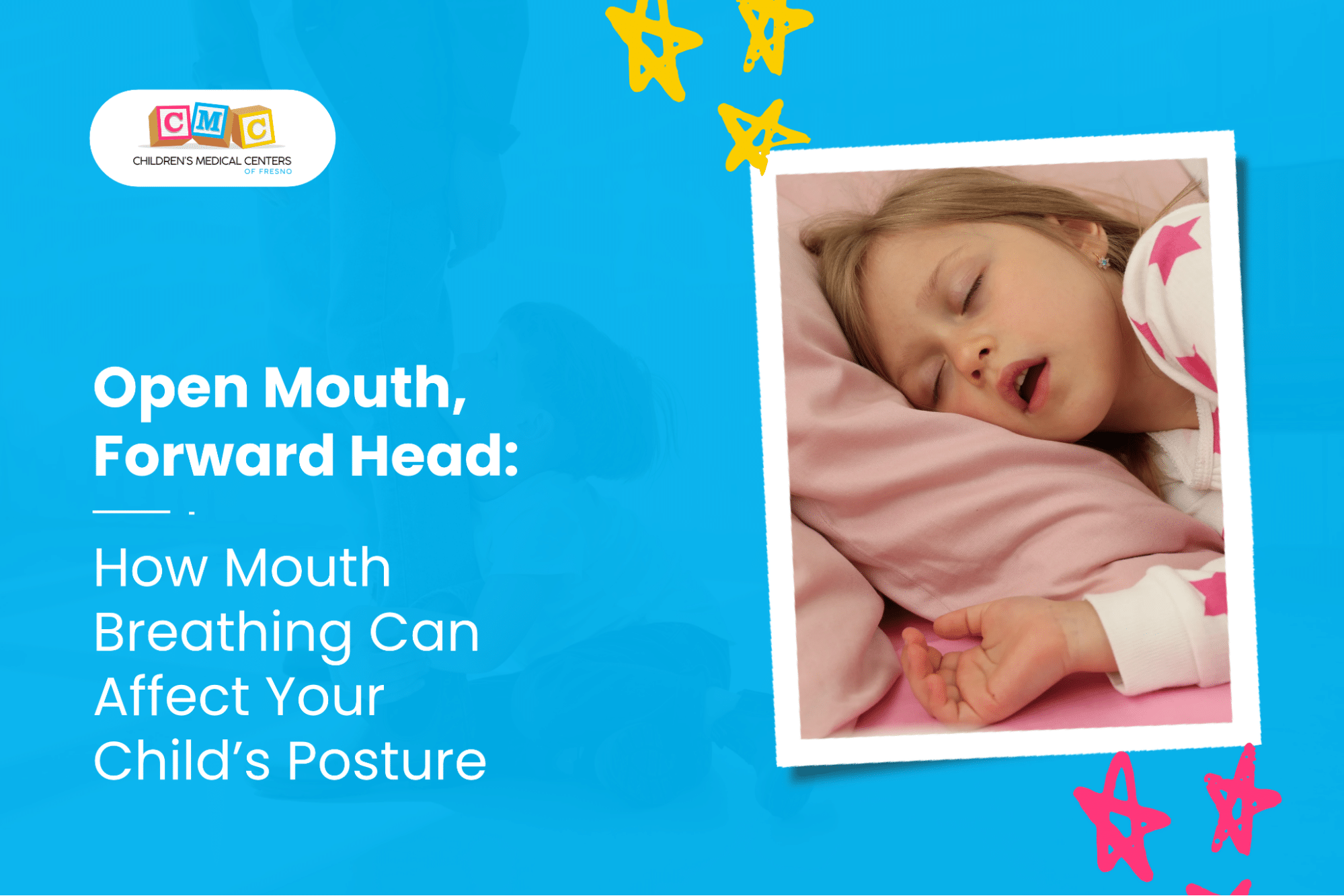
You check on your child before bed and notice their mouth is hanging open. It’s a small thing, and most parents let it go. But if it keeps happening, it’s fair to wonder what’s behind it.
At CMCFresno, families often tell us about snoring, tiredness, and a head that sits a little too far forward. These details seem small, but together they can tell us how your child is breathing.
This guide to mouth breathing and posture in children explains what to look for, why it happens, and how we can help.
Worried About Your Child’s Breathing?
Book a visit with CMCFresno today
What Is Mouth Breathing in Children?
Mouth breathing in children means regularly breathing through the mouth instead of the nose, during the day, at night, or both. Child mouth breathing is very common during a cold or allergy flare, and a few stuffy days are nothing to fear.
What we pay attention to is the pattern. When it continues for weeks or months, it may point to something making nasal breathing difficult.
The nose works hard for your child. It filters dust, warms and moistens the air, and supports calm, steady breathing. A 2025 review in the National Library of Medicine’s PubMed database looks at how oral breathing relates to dental and facial development in children.
Can Mouth Breathing Affect a Child’s Posture?
Yes, it can play a part. Some children tilt the head forward or lift the chin to open the airway more easily. Over time, this may show up as forward head posture in kids, rounded shoulders, or a slouched upper back.
The tongue and jaw may also rest differently when a child breathes through the mouth, which can influence how the neck and shoulders are held. This open-mouth posture is the body adapting, even when the adaptation isn’t ideal.
We want to be honest that research is still growing, and posture has many influences, including backpacks, screens, and muscle strength. A systematic review on PubMed Central found the link between mouth breathing and posture in children is still unclear. One study of children with mouth breathing syndrome reported more postural problems than in nose-breathing children. Mouth breathing is one possible piece, not a guaranteed cause.
What Are the Signs of Mouth Breathing and Posture Changes?
The clearest clue is a child who keeps their lips apart while resting. You may also notice snoring in children, noisy breathing, restless sleep, dry or cracked lips, bad breath, or a nose that always seems stuffy.
Posture clues can include a head that sits forward of the shoulders or shoulders that roll inward. Some children also have dark circles under their eyes, or seem tired, irritable, or distracted during the day.
One sign alone often means very little, but several together deserve a closer look.
What are Common Causes of Mouth Breathing in Children?
Most of the time, the causes of mouth breathing come down to something making the nose hard to breathe through. Allergies and ongoing congestion are the most common. Enlarged adenoids in children, along with enlarged tonsils, are another frequent cause.
A deviated septum, repeated sinus infections, or asthma can also play a role. In some children, a structural difference such as a tongue-tie makes nasal breathing harder.
Sometimes the original problem clears up, but the habit stays. That is not your child’s fault, and it is not something to scold. Finding the true reason helps us choose the kindest, most effective plan.
How Can Mouth Breathing Affect Sleep and Daily Comfort?
Nighttime is often where mouth breathing shows its effects. Children may snore, wake frequently, or have sleep-disordered breathing, including obstructive sleep apnea.
The next day can bring sleepiness, mood swings, restlessness, or trouble keeping up at school. Parents often tell us they assumed it was behavior, only to learn poor sleep was part of the story. A dry mouth can also raise the chance of cavities and sore gums.
How Is Mouth Breathing Evaluated in Children?
Evaluation begins with a conversation. We listen to your concerns, ask about sleep, allergies, and family history, and look carefully at your child’s nose, mouth, and throat. You know your child best, and your observations matter.
Depending on what we find, we may suggest an ear, nose, and throat specialist, an allergist, or a dentist or orthodontist. If sleep apnea is a concern, a sleep study may be recommended, and the American Academy of Sleep Medicine’s patient site explains what to expect.
When posture or oral habits seem involved, a physical therapist or myofunctional therapist may join the team to provide an appropriate pediatric breathing treatment. The goal is to understand why your child is breathing this way before deciding on a path.
How Can Parents Help a Child Who Mouth Breathes?
Support depends on the cause, and we will guide you every step of the way. Allergies may be eased with fewer triggers, saline rinses, or medicine, and infections or congestion can be treated directly.
Enlarged tonsils or adenoids may be evaluated if they seem to block the airway. Once breathing is easier, gentle reminders to keep lips closed can help, offered with patience rather than pressure.
At home, movement, stretching, and comfortable screen positioning support better posture. Please avoid mouth tape or similar devices unless a healthcare professional recommends them. It’s also important to check with your doctor for child growth services to make sure that your little one is right on track.
When Should Parents Seek Medical Care?
Consider scheduling a visit if your child breathes through the mouth most of the time for more than a few weeks, snores regularly, or seems to pause in breathing during sleep. These are some of the pediatric breathing problems we most want to catch early.
Ongoing tiredness despite enough rest, frequent ear or throat infections, and noticeable posture changes or neck and back discomfort are also good reasons to check in. No concern is too small.
If your child struggles to breathe, has bluish lips, or seems to be fighting for air, seek urgent care right away. Trust your instincts, and never feel silly for asking. Our sick visit services are available, one call away.
You’re Not Overreacting: Next Steps for Your Child’s Breathing

Mouth breathing isn’t always a problem, but when it becomes a daily pattern, it can touch on sleep, comfort, and sometimes posture. The encouraging news is that once the cause is found, there is usually a clear way to help.
If you have noticed ongoing mouth breathing in children’s daily habits, or posture changes in your own child, you are not overreacting. Paying attention is one of the most loving things a parent can do.
Our team at CMCFresno is here to listen, evaluate, and walk beside your family, with pediatric breathing treatment options tailored to your child. We also provide well-child exams and other pediatric services to check for your child’s holistic growth.
Help Your Child Breathe Easier
Call CMCFresno to book now
FAQs
Occasional mouth breathing during a cold or allergy flare is completely normal. If it continues for weeks, happens mostly at night, or comes with snoring and tiredness, it is worth a closer look. The team at CMCFresno can help you work out whether it is a passing phase or something that needs care.
The most common causes of mouth breathing are allergies, nasal congestion, and enlarged tonsils or adenoids. Less often, a deviated septum, asthma, or a tongue-tie is involved. At CMCFresno, we focus on finding the cause first so treatment fits your child.
Sometimes, especially when allergies or infections clear up. But when the cause is something like enlarged adenoids or a narrow nasal airway, the habit often stays until that cause is treated. An early evaluation at CMCFresno can bring real peace of mind.
In some children, long-term mouth breathing during the growing years has been linked to changes in the face and jaw. Not every child is affected, and many factors play a part. This is why early attention matters, and why our clinic takes a careful, whole-child approach.
Exercises may help improve posture, but they can’t clear a blocked airway. The cause needs to be found first, and then the right combination of treatment and support can follow. At CMCFresno, we look at breathing and posture together so your child gets a plan that fits.
Come in if mouth breathing, snoring, restless sleep, or posture changes have lasted more than a few weeks, or if you simply feel something is off. You do not need a perfect description of the problem. Call or message our office to schedule a visit, and our team will help you take the next step with confidence.

 inquiry@cmcfresno.com
 (559) 455-1500